
Learning Support
Language, Literacy and Numeracy (LLN)
All Vocational training requires a minimum level of LLN, so if you have a learning difficulty or disability, we may be able to assist, however our LLN support is limited as we do not have a foreign speaker, or a learning specialist on the team to support those with severe learning difficulties. You must decide if our level of support is what you require.
Please also consider all, assessment is in English and there is a requirement to read and write English to a basic level in order to engage with Legislation and Policies, as is required by the regulators.
All students also undertake a LLN Quiz at the commencement of the course. This may indicate some support may be required.
Reasonable Adjustment
A reasonable adjustment is when an alternative method to assist learners to undertake their assessment. Reasonable adjustment can be made if a learner does have a learning difficulty or disability. Do you think this applies to you? Please contact us.
You still have to do the assessment and you are still required to meet all requirements of the training package.
Access and Equity
Access All Areas Training is committed to providing training and assessment services to all clients regardless of race, religion, sex, socio-economic status, disability, language, literacy or numeracy.
Access All Areas Training provides assistance to all clients to identify and achieve their desired outcomes.
Access All Areas Training upholds the principles of equal opportunity.
We encourage you to contact us, if you have a question in regards to any of these topics or you believe you need some additional support - info@aaat.edu.au
Responsible Service of Alcohol (RSA) HUB - 2025
Legal Responsibilities for Staff – Responsible Service of Alcohol (RSA) 2025
This fact sheet outlines the legal obligations of staff who sell, serve, or supply alcohol in Australia. These responsibilities apply to all workers in licensed venues, regardless of position or experience, and reflect national laws aimed at promoting safe, responsible, and lawful alcohol service.
1. Do Not Serve Alcohol to Minors
- It is illegal to sell, serve or supply alcohol to anyone under 18 years of age.
- Check ID for anyone who appears under 25 years old.
- Only approved photo ID is acceptable (driver licence, passport, Keypass, Proof of Age card).
- If in doubt, refuse service.
- Penalties apply to both the business and the staff member personally.
2. Do Not Serve Alcohol to Intoxicated Persons
- Do not serve alcohol to any person showing clear signs of intoxication such as slurred speech, unsteady movement, or aggression.
- Refuse further service and, if necessary, ask the person to leave the premises.
- Record refusals in the incident or refusal register if applicable.
3. Prevent Intoxication Before It Happens
- Take reasonable steps to prevent intoxication by slowing or refusing service.
- Offer water and food options regularly.
- Promote non-alcoholic and low-alcohol drinks.
- Engage with customers politely to encourage responsible drinking.
4. Promote a Safe Drinking Environment
- Be alert to risky behaviour and disorderly conduct.
- Encourage moderation and intervene early where needed.
- Ensure drinking water is freely available and visible.
- Report safety or security issues to management immediately.
5. Follow the Venue’s RSA and House Policy
- Comply with the venue’s RSA and House Policy at all times.
- Understand your venue’s specific procedures for ID checks, cut-off times, and incident reporting.
- Failure to comply may lead to internal disciplinary action or legal consequences.
6. Report Incidents or Concerns
- Report refusals of service, fake IDs, or disorderly conduct to the Responsible Person or Manager.
- Document incidents clearly and promptly in the venue’s log.
- Assist management and authorities when investigations occur.
7. Hold a Valid RSA Qualification
- Complete the nationally recognised RSA unit (SITHFAB021) or the state-approved version.
- Keep your RSA certificate or competency card with you while working.
- Renew or refresh your RSA as required in your state (e.g. NSW – every 5 years, VIC – every 3 years).
8. Understand Personal Liability
- You can be fined personally for serving alcohol illegally or ignoring RSA laws.
- Fines apply for serving minors, intoxicated persons, or failing to remove disorderly patrons.
- If unsure, do not serve and seek advice from your manager or responsible person.
This fact sheet provides general legal guidance for hospitality staff. Always follow your venue’s procedures and consult your state or territory regulator for specific legislative requirements.
NSW – Liquor & Gaming NSW
VIC – Victorian Gambling & Casino Control Commission
QLD – Office of Liquor & Gaming Regulation
WA – Department of Local Government, Sport and Cultural Industries
SA – Consumer and Business Services
TAS – Department of Treasury and Finance
ACT – Access Canberra
NT – Director of Liquor Licensing
RSA Brief Summary – Techniques for Responsibly Refusing Service (2025)
A quick reference guide for hospitality staff on how to refuse alcohol service safely and professionally. These align with RSA laws and help protect both you and your venue.
🚨 Recognise When to Refuse
- Refuse service to anyone who is intoxicated, under 18, or using fake ID.
- Watch for signs of intoxication – slurred speech, poor balance, aggression, loudness, or glassy eyes.
- Act early – prevention is easier than confrontation.
😌 Stay Calm and Professional
- Be polite, respectful, and confident – stay calm under pressure.
- Use a steady tone and open body language.
- Never argue, raise your voice, or touch the customer.
- Call a supervisor or security if you feel unsafe.
🗣️ Use Clear and Simple Language
Be direct but respectful:
- “I’m sorry, I can’t serve you another drink — you appear to have had enough for now.”
- “It’s against the law for me to serve alcohol to anyone who seems intoxicated.”
Avoid blaming language like “you’re drunk” – focus on the law and your duty.
🥤 Offer Alternatives
- Offer water, soft drink, or food instead of alcohol.
- Suggest taking a break or calling a taxi/rideshare.
- Involve your manager if the customer challenges your decision.
👥 Get Team Support
- Let other staff know not to serve the person.
- Ask your Approved Manager or Responsible Person to assist.
- Record the incident in the venue’s refusal or incident log.
⚠️ Handling Difficult Situations
- If the person becomes aggressive, step back and maintain distance.
- Ask for help from security or management.
📝 Record and Review
- Document all refusals – include time, description, and witnesses.
- Discuss incidents in team meetings to improve handling and safety.
RSA Brief Summary – Age and ID Verification Requirements (2025)
This guide summarises legal requirements for checking identification (ID) and verifying age across all Australian states and territories. It supports staff in ensuring alcohol is not served to minors and that lawful age verification procedures are followed.
🪪 National Rules (All States & Territories)
- It is illegal to sell or supply alcohol to anyone under 18 years old.
- Check ID if the person appears under 25 (industry best practice).
- Acceptable photo ID includes:
- Current Australian driver licence or learner permit.
- Australian or foreign passport
- Proof of Age or Keypass card (digital or physical).
State-issued photo card (e.g. NSW Digital ID).
- ID must be current (not expired) and genuine.
- Refuse service if the ID appears fake, altered, or uncertain.
📍 State and Territory Requirements
- In New South Wales (NSW), the minimum age is 18. Acceptable ID types include a driver licence, passport, NSW Photo Card, or Digital ID. Fines apply if ID is not checked, and some precincts require electronic ID scanning.
- In Victoria (VIC), the minimum age is 18. Approved IDs are a driver licence, passport, Proof of Age card, or Keypass. Age must be verified before entry to restricted areas, and expired IDs are not accepted.
- In Queensland (QLD), the minimum age is 18. Accepted IDs include a driver licence, passport, Proof of Age card, or Keypass. ID scanners are mandatory in Safe Night Precincts, and service must be refused if the ID is invalid.
- In Western Australia (WA), the minimum age is 18. Valid IDs are a driver licence, passport, Proof of Age card, or Keypass. Service should be refused if there is any doubt, and police may inspect IDs at any time.
- In South Australia (SA), the minimum age is 18. Accepted forms of ID include a driver licence, passport, Proof of Age card, or Keypass. Digital IDs are accepted if verifiable, and staff must check ID upon request.
- In Tasmania (TAS), the minimum age is 18. Valid IDs include a driver licence, passport, Proof of Age card, or Keypass. ID must be checked if a person appears under 25, and authenticity should be verified carefully.
- In the Australian Capital Territory (ACT), the minimum age is 18. Approved IDs are a driver licence, passport, Proof of Age card, or Keypass. Proof of age is required before sale in licensed areas, and digital IDs are accepted.
- In the Northern Territory (NT), the minimum age is 18. Valid IDs include a driver licence, passport, Proof of Age card, or Keypass. The Banned Drinker Register applies, meaning all IDs must be scanned before any sale.
✅ Quick Tips
- Always ask politely and thank customers for showing ID.
- Refuse service if the ID looks tampered, expired, or suspicious.
- If in doubt — don’t serve. The law protects you when refusing responsibly.
- Record fake or suspicious ID incidents in the venue’s incident log.
RSA Brief Summary – Legal Responsibilities (2025)
A quick reference guide for all staff serving or supplying alcohol in licensed venues. Follow these key responsibilities to meet your legal obligations under Australian RSA laws.
🚫 Serving Alcohol to Minors
- Never serve alcohol to anyone under 18.
- Check ID if the person looks under 25.
- Accept only photo ID (Licence, Passport, Proof of Age, Keypass).
- If unsure, politely refuse service.
🥴 Serving Intoxicated Customers
- Do not serve anyone showing signs of intoxication (slurred speech, aggression, unsteady balance).
- Offer water or food instead, and stop further alcohol service.
- Record the refusal in the incident log if required.
⚖️ Preventing Intoxication
- Monitor customers and slow or refuse service early.
- Encourage breaks, water, or food between drinks.
- Promote non-alcoholic and low-alcohol options.
🏠 Follow Venue & RSA Policy
- Know your venue’s RSA and House Policy – ID checks, cut-off times, and reporting rules.
- Report any issues or unsafe behaviour to your Manager or Responsible Person.
📄 Record & Report
- Document all refusals, fake IDs, or incidents immediately.
- Assist authorities if asked – your notes protect both you and the venue.
🎓 RSA Qualification
- Hold a valid RSA certificate or card while working.
- Renew your RSA as required – NSW every 5 years, VIC every 3 years.
- Keep your certificate or digital copy on hand for inspections.
⚠️ Personal Liability
- You can be fined personally for breaking RSA laws.
- When in doubt – don’t serve.
Common Obligations for Liquor Licensees Across Australia (2025)
This fact sheet outlines the common obligations that apply to liquor licensees across all Australian states and territories. While each jurisdiction operates under its own liquor legislation, these responsibilities are consistent nationwide and reflect the principles of responsible service, harm minimisation, and public safety.
1. Responsible Service of Alcohol (RSA)
- All staff who sell, supply or serve alcohol must hold a current RSA qualification.
- Licensees must verify and record RSA credentials for all staff.
- Service to minors or intoxicated persons is strictly prohibited.
- RSA refresher or renewal may be required for some states (e.g. NSW, VIC, ACT).
2. Display & Documentation Requirements
- Liquor licence and RSA signage must be displayed at all times.
- Maintain incident, training and refusal logs for inspection.
- Premises plan with licensed areas must be current and accessible.
- Keep staff RSA certificates/cards and responsible person rosters on file.
3. Responsible Promotion & Advertising
- Do not promote rapid or excessive alcohol consumption.
- Avoid advertising that targets minors or uses offensive imagery.
- Ensure discounts and promotions comply with local advertising rules.
4. Responsible Person / Approved Manager On-Duty
- A responsible person or approved manager must be present whenever alcohol is sold or supplied.
- Their name must be displayed or recorded for public and inspector reference.
- They must ensure full compliance with RSA and licence conditions.
5. Preventing Sale to Minors
- Check ID for anyone who appears under 25 years of age.
- Accept only approved photo ID such as a driver licence, passport or proof-of-age card.
- If in doubt, refuse service.
6. Refusing Service to Intoxicated or Disorderly Persons
- It is illegal to serve alcohol to an intoxicated person.
- Take reasonable steps to prevent intoxication (e.g. offer water, stop service).
- Remove intoxicated or disorderly patrons and record refusals in an incident register.
7. Noise, Security & Public Safety
- Manage noise and patron behaviour within and outside the venue.
- Ensure safety of staff and patrons through adequate lighting and crowd control.
- Provide access to safe transport options for departing patrons.
8. Compliance & Inspections
- Inspectors and police may enter premises at any time to check compliance.
- Follow all licence conditions including trading hours and area restrictions.
- Breaches can result in fines, suspension or cancellation of licence.
9. Record Keeping
- Maintain records of RSA training, incidents, complaints and security rosters.
- Records must generally be kept for a minimum of 12 months (varies by state).
10. Duty of Care & Harm Minimisation
- Provide free drinking water and non-alcoholic options.
- Promote a safe, responsible drinking environment.
- Cooperate with police and local safety initiatives.
This fact sheet provides general guidance only. For detailed legislative requirements, refer to the relevant state regulator:
NSW – Liquor & Gaming NSW
VIC – Victorian Gambling & Casino Control Commission
QLD – Office of Liquor & Gaming Regulation
WA – Department of Local Government, Sport and Cultural Industries
SA – Consumer and Business Services
TAS – Department of Treasury and Finance
ACT – Access Canberra
What is RSA Training?
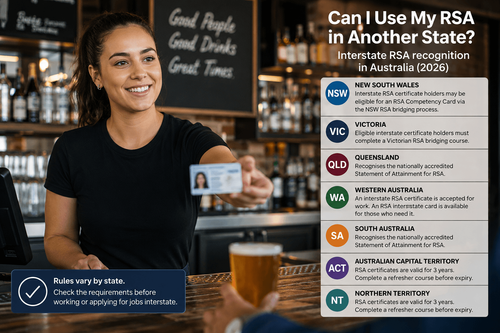
Responsible Service of Alcohol (RSA) Training is required anywhere in Australia if you want to work in, deliver, serve or supply alcohol in licensed venues. There is a Nationally accredit Unit SITHFAB021 - Provide Responsible Service of Alcohol, which covers the main mandatory content, and then some States or Territories add their own specific requirements or content on top.
What is the same across all states?
- RSA training is mandatory for people who sell, serve or supply alcohol in licensed premises.
- You must not serve alcohol to minors (under 18) or to people who are intoxicated.
- Staff are expected to intervene responsibly to refuse service where someone is or ir approaching intoxication (refuse service, offer water, manage risks).
- RSA courses must be delivered by approved/registered training providers (RTOs or state-approved ones) such as Access All Areas Training.
- There is a “nationally recognised” component (SITHFAB021) often used as the base RSA unit.
Below you can find the requirements for each State in Australia
What are the requirements for RSA training in Western Australia?
Regulator: Department of Local Government, Sport and Cultural Industries (DLGSC)
Course requirement: National RSA unit (SITHFAB021)
Renewal: No expiry
Mode: Classroom and Online allowed via approved RTOs.
Recognition: Accepted interstate for national part, but not valid for NSW or Victoria
Key obligations:
- RSA required before working.
- Venue licensees must maintain training records.
What are the requirements for RSA training in New South Wales?
Regulator: Liquor & Gaming NSW
Course requirements: Must complete a NSW-approved RSA course with a NSW Approved Training Organisation and then get a NSW Competency Card showing your accreditation.
Renewal: Need to complete a “refresher” and renew your Competency Card every 5 years .
Mode: Classroom and Online permitted only through L&G NSW–approved providers.
Recognition: Not automatically recognised in other states due to NSW-specific requirements. Some training providers will issue the National Certificate of Attainment alongside the NSW specific certificate.
Key obligations:
- Must refuse service to minors and intoxicated persons.
- RSA card must be carried while working.
- Staff must keep their details current using the L&G NSW portal
What are the requirements for RSA training in Victoria?
Regulator: Liquor Control Victoria
Course requirement: Must complete the National RSA unit with a Liquor Control Victoria Approved Training Organisation
Renewal: Need to complete a refresher every 3 years.
Mode: Classroom and Online permitted only if provider approved by LCV.
Recognition: Accepted in all states except NSW (needs bridging unit)
Key obligations:
- Display RSA certificate at the venue.
- Managers must keep copies of all staff certificates.
What are the requirements for RSA training in Queensland?
Regulator: Office of Liquor and Gaming Regulation (OLGR)
Course requirement: National RSA unit (SITHFAB021)
Renewal: No expiry, but refresher encouraged every 3 years.
Mode: Classroom and Online allowed via any RTO accredited to deliver this unit.
Recognition: Accepted in all states except NSW (needs bridging unit).
Key obligations:
- RSA required within 30 days of commencing work.
- Event staff must also hold valid RSA.
What are the requirements for RSA training in South Australia?
Regulator: Consumer and Business Services (CBS)
Course requirement: National RSA unit (SITHFAB021)
Renewal: No expiry
Mode: Classroom and Online allowed via approved RTOs.
Recognition: Accepted interstate for national part, but not valid for NSW or Victoria
Key obligations:
- RSA required before working.
- Venue licensees must maintain training records.
What are the requirements for RSA training in the Northern Territory?
Regulator: Director of Liquor Licensing (DCLL)
Course requirement: National RSA unit (SITHFAB021)
Renewal: Need to complete refresher training every 3 years
Mode: Classroom and Online allowed via approved RTOs.
Recognition: Accepted interstate for national part, but not valid for NSW or Victoria
Key obligations:
- Mandatory for all front-line staff.
- Some remote communities require additional alcohol management training.
What are the requirements for RSA training in the ACT?
Regulator: Access Canberra
Course requirement: National RSA unit (SITHFAB021)
Renewal: Need to complete refresher training every 3 years
Mode: Classroom and Online allowed via approved RTOs.
Recognition: Accepted interstate for national part, but not valid for NSW or Victoria
Key obligations:
- Venue must keep staff RSA copies.
- Responsible persons must complete additional training.
What are the requirements for RSA training in the Tasmania?
Regulator: Department of Treasury and Finance (Liquor and Gaming Branch)
Course requirement: National RSA unit (SITHFAB021) plus Tasmania content
Renewal: No expiry
Mode: Classroom and Online allowed via approved RTOs.
Recognition: Accepted interstate for national part, but not valid for NSW or Victoria
Key obligations:
- RSA required within 3 months of employment.
- Refresher suggested every few years by industry.
Latest News