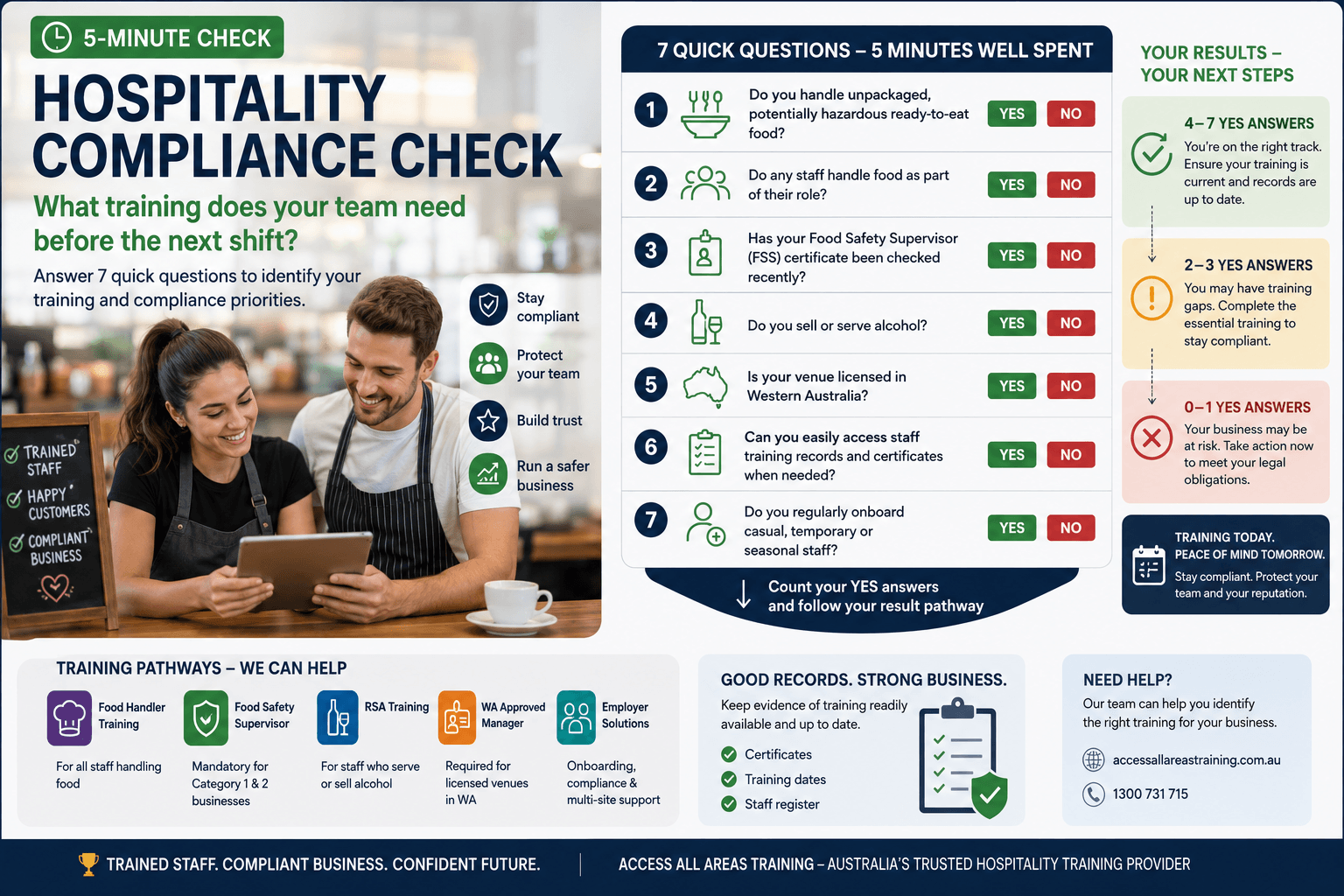
A practical 2026 self-check for cafes, restaurants, takeaway outlets, bars, pubs, bottle shops, caterers and food retailers across Australia
Quick answer: the right training pathway depends on what your business does, what your staff handle, whether alcohol is supplied and where the venue operates. Use the five-minute self-check below to identify the areas that need closer attention before your next shift, new starter induction or venue opening.
Running a hospitality or food-service business is rarely about one certificate. A cafe may need to think about food-handler training, a Food Safety Supervisor and evidence records. A restaurant that supplies alcohol may also need RSA-trained staff. A licensed venue in Western Australia may need an approved manager present while the business is operating.
The problem is that owners and managers often discover a training gap at the worst possible time: during onboarding, before a busy weekend, when a staff member leaves unexpectedly or when a compliance issue is raised.
This self-check is designed to help you identify the questions that matter first. It is general information only. Your exact obligations may depend on your business activities, licence type, state or territory and the advice of your regulator or local government authority.
1. Do you handle unpackaged, potentially hazardous food that is ready to eat?
Examples can include cooked meat, seafood, dairy products, cooked rice, pasta, prepared salads and other foods that may require temperature control to remain safe.
☐ Yes — our team prepares, handles, displays or serves these foods.
☐ Sometimes — it depends on the menu, service model or event.
☐ No — we do not handle this type of food.
What to do next: If you answered “Yes” or “Sometimes”, review whether Standard 3.2.2A applies to your business. Food service, catering and related retail businesses may need trained food handlers, an appointed Food Safety Supervisor and, for some businesses, evidence records for critical food-safety controls.
2. Do staff members handle food as part of their role?
This includes kitchen staff, cafe staff, catering staff, takeaway teams and other workers involved in preparing, serving or handling relevant food.
☐ Yes — multiple staff members handle food.
☐ Yes — only one or two people handle food.
☐ No — staff do not handle food.
What to do next: If staff members handle relevant food, do not assume that appointing one Food Safety Supervisor automatically covers the wider team. Review the food-handler training requirements that apply to your business and make sure training records are easy to locate.
3. Has your Food Safety Supervisor certificate been checked recently?
A Food Safety Supervisor should be appropriately trained and reasonably available to advise and supervise food handlers. Under Standard 3.2.2A, the certificate generally needs to have been issued within the previous five years.
☐ Yes — the certificate is current and stored with our records.
☐ We have an FSS, but we need to confirm the certificate date.
☐ We do not currently have an appointed FSS.
☐ We are not sure whether our business needs one.
What to do next: If the certificate date is uncertain, or if the appointed supervisor is no longer available during normal operations, treat this as a priority review item.
4. Does your business supply, sell or serve alcohol?
RSA requirements vary by state and territory. The correct course or recognition pathway can also depend on where the employee will work.
☐ Yes — staff sell or serve alcohol.
☐ We plan to add alcohol service soon.
☐ No — alcohol is not supplied.
What to do next: If you answered “Yes” or “We plan to add alcohol service soon”, confirm that the relevant staff members have completed the correct RSA pathway for the jurisdiction where they will work. Do not assume that every interstate certificate is automatically accepted in the same way.
5. Is your venue licensed in Western Australia?
Licensed premises in WA have specific approved-manager requirements. The licensee must ensure the premises are appropriately supervised while business is conducted.
☐ Yes — we operate a licensed WA venue.
☐ We are applying for, acquiring or opening a licensed WA venue.
☐ No — this does not apply to our business.
What to do next: If you operate or are preparing to operate a licensed WA venue, confirm whether the relevant manager needs a restricted or unrestricted approved-manager pathway and whether the required card and supporting records are current.
6. Can you locate your team’s training records quickly?
A training record is only useful if it can be found when needed. Staff turnover, multiple sites and casual rosters can create gaps quickly.
☐ Yes — records are centralised and checked regularly.
☐ Records exist, but they are spread across emails, folders or sites.
☐ We are not confident the records are complete.
What to do next: If records are fragmented, create one central register showing each staff member, role, location, course completed, certificate date and review date. Assign responsibility for checking it regularly.
7. Are you onboarding new or casual staff before a busy period?
Compliance gaps often appear when venues hire quickly for seasonal trade, events, festivals or weekend shifts.
☐ Yes — recruitment or onboarding is underway.
☐ We use casual or relief staff regularly.
☐ No — staffing is stable.
What to do next: If staffing changes frequently, include a training check in the onboarding process before the employee is rostered into duties that require specific training or certification.
Your results: where should you start?
Priority 1: Your staff handle food
Review your Food Handler training pathway and determine whether your business also needs an appointed Food Safety Supervisor. If your activities fall within category one requirements, review the evidence tool and record-keeping obligations as well.
Priority 2: Your team sells or serves alcohol
Confirm the RSA requirements for the state or territory where the work will occur. Check whether staff need a new course, a state-specific pathway, a bridging process or a refresher course.
Priority 3: You operate a licensed venue in WA
Confirm whether the manager responsible for the premises requires a restricted or unrestricted approved-manager pathway. Check whether the approved-manager card and related records remain current.
Priority 4: Your records are scattered or incomplete
Create a central training register before the next roster cycle. A simple review can reveal expired certificates, missing records, staff trained for the wrong jurisdiction or new starters who still need training.
Simple staff-training register
Use a central register so training gaps can be identified before a shift is assigned. Add columns where required for your business, licence type or regulator guidance.
Staff member Role Venue / state Training required Certificate date Review date
Why this check matters
Compliance training should not be treated as a once-only onboarding task. Menus change. Staff move between venues. New sites open. Employees leave. Certificates age. State-specific requirements can also create confusion when workers relocate or pick up seasonal work.
A short, scheduled training review gives owners and managers a clearer picture of what is current, what is missing and what needs to be confirmed with the relevant authority.
The goal is not to collect certificates for the sake of it. The goal is to make sure each worker has the right training pathway for the role they actually perform.
Choose the right AAAT training pathway
Access All Areas Training (AAAT) is an Australian-owned Registered Training Organisation (RTO 52312) delivering online training across key hospitality compliance areas. Depending on your role, workplace and jurisdiction, the relevant pathway may include:
• Responsible Service of Alcohol (RSA) training
• Food Handler training
• Food Safety Supervisor training
• WA Approved Manager training
• Employer and multi-site training solutions
Review the available courses: www.accessallareastraining.com.au/courses
Need to train multiple team members or review pathways across several locations? Contact AAAT to discuss your requirements before enrolling staff.
Important information
Disclaimer: This article provides general information only. It is not legal advice and does not replace guidance from the relevant regulator, local government authority or licensing authority. Requirements vary by state, territory, business activity, licence type and individual circumstances. Businesses should confirm their obligations before relying on a training pathway.
Official reference links
• FSANZ: Standard 3.2.2A – Food Safety Management Tools
• FSANZ: Food Handler Training
• FSANZ: Food Safety Supervisor
• WA Government: Mandatory Training for Licensees, Approved Managers and Employees
About Access All Areas Training
Access All Areas Training (AAAT) has been delivering nationally accredited hospitality compliance training across Australia for over 20 years. As a registered training organisation (RTO 52312) approved by the Australian Skills Quality Authority (ASQA), AAAT has helped more than 200,000 students complete their RSA, Food Safety and Approved Manager training. AAAT is also an approved training provider under the NSW Food Authority (provider number 25813).
Disclaimer: The information in this article is provided for general guidance only and reflects regulatory requirements at the time of writing. Regulatory requirements and state-specific rules can change. Students are encouraged to verify current requirements with the relevant state or territory authority before enrolling in any course.